

A well-designed salon does a lot of things at once. It puts clients at ease, gives stylists room to work efficiently, and demonstrates the standards of the business before a single service begins. Air quality is a critical factor in all of these areas. The right ventilation infrastructure can be built into a space as naturally as lighting, cabinetry, or seating.
Source capture ventilation works by removing chemical vapors, particulate matter, and fumes at the point of release rather than waiting for overhead vents to cycle them out of the room. Source capture systems create a healthier environment for stylists and clients as well as an atmosphere that functions as well as it looks. This guide walks through how to integrate localized extraction into different salon blueprints without compromising workflow or the visual identity of your space.
Generating Hair Salon Design Ideas from Your Blueprint
No two salons share the same floor plan, and a hair salon fume extractor positioned perfectly in one layout can obstruct movement or look out of place in another. Before selecting equipment or deciding on placement, map the following elements of your space:
- Station orientation
- Traffic flow between chairs
- Location of shampoo bowls
- Structural columns or built-in cabinetry
- The path stylists take when moving between clients
These factors determine how many units you need, where each one will live between uses, and how the extractor arm will be positioned during services. Freestanding, caster-based systems like the SPA-H Hair Salon Fume Extractor are particularly well-suited to this kind of planning because they move with the work rather than requiring the salon to be built around them.
Integrating Hair Salon Ventilation Into Open-Plan Designs
Open layouts are popular in modern hair salons because they feel spacious, allow natural light to travel freely, and create a social atmosphere that clients enjoy. They also present a significant ventilation challenge, since there are no partitions to contain fumes and stylists are likely working in close proximity across a shared floor.
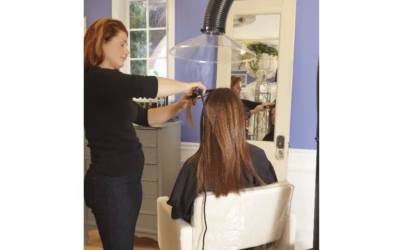
In these spaces, freestanding source capture units with rolling caster bases offer the most flexibility. A unit can be positioned at whichever station is in active use, repositioned between clients, and tucked neatly beside the styling chair when the extractor arm is not deployed. Because the SPA-H operates as a recirculating system, there is no ductwork to route and no structural modification required. This offers a notable advantage in open-plan spaces where walls and ceilings are part of the aesthetic.
For salons with multiple stations running simultaneously, placing a dedicated unit at each active chair removes any guesswork about coverage and ensures that every stylist has consistent access to comprehensive source capture protection throughout the day.
Booth and Semi-Private Station Configurations
Booth-style salon layouts, where low partitions or shelving divide individual stations, offer more natural containment and make positioning simpler. A freestanding unit slides into the booth footprint beside the chair, and the extractor arm extends to the capture position overhead during chemical services. Between appointments, the arm retracts and the unit occupies the same space as a styling trolley or product cart.
For semi-private setups with taller dividers, the space-saving tower footprint of the SPA-H (12.5″ W x 12.5″ D) means it fits into the station without encroaching on the stylist’s working area. The wide 16-inch source capture hood that comes standard with the SPA-H is also a thoughtful detail in booth environments, providing wide, effective containment right above the client’s head during heavy processing.
Chemical Stations and Color Bars
We recommend paying special attention to color bars and mixing stations in your salon ventilation plan. These zones generate concentrated fumes during mixing and application, and stylists often spend extended time at them without moving far. A source capture unit positioned at the color bar addresses the mixing phase, and a second unit at the chair handles the application and processing period when product is sitting on the hair and off-gassing continuously.
This two-unit approach, with one at the prep station and one at the chair, is easy to implement with freestanding systems and creates a clean handoff between the two highest-exposure phases of a chemical service. It also gives you flexibility to add coverage incrementally as your business grows, rather than committing to a fixed installation that cannot adapt to a changing floor plan.
Protecting Stylist Workflow
The most technically sound hair salon ventilation system falls short in practice if it slows stylists down or forces them to work around equipment rather than with it. Every element of source capture setup should support the way stylists already move.
The SPA-H rigid flex extractor arm is designed with salon ergonomics in mind. It extends to a true overhead position without angled joints that would restrict airflow or require awkward maneuvering, and the variable speed control lets stylists dial the extraction rate to the service being performed. A high-volume color service calls for a different setting than a trim with a light styling product, and having full control at the station makes the system versatile across a full book of clients.
Do You Need Fume Extraction at Every Styling Station?
Some salon owners begin by installing extraction at the stations where chemical services are most common, treating it as a targeted solution for the highest-exposure moments. That approach resolves the most concentrated release points, but it misses the cumulative air quality burden that builds across a full day of work.
Heat styling releases particulate matter. Hairspray disperses at chair level. Smoothing treatments and keratin services produce formaldehyde and other volatile compounds that linger long after the application is complete. A source capture ventilation system at every styling station creates a consistent air quality standard throughout the space, protects the whole team equally, and removes the guesswork about which zones are adequately covered.
Seamlessly Implement Source Capture Ventilation Systems with Salon Pure Air
The best hair salon design ideas treat ventilation as an important piece of the puzzle. A freestanding source capture unit in a powder-coated black or white finish sits comfortably alongside modern salon furniture, and its compact base takes up less visual real estate than most styling trolleys. When the extractor arm is retracted, the unit reads as equipment that belongs in the space rather than something grafted onto it.
When source capture ventilation is thoughtfully integrated into the salon environment, your space looks considered from every angle, performs at a higher level for the people working in it, and tells clients that you value their wellbeing.
Ready for an air quality makeover? At Salon Pure Air®, we’re passionate about creating cleaner, safer, and more comfortable environments for beauty professionals and their clients. Contact us today to discuss your ventilation options and see how they can improve your salon space.