

The organic salon movement has brought truly meaningful changes to the industry. Lower-toxicity formulas, plant-derived pigments, and a commitment to client wellness have raised the bar across the board. Booking an appointment at an organic hair salon carries a specific expectation that the environment itself is healthier, cleaner, and more carefully considered than the conventional salon.
The elevated expectation is largely warranted, but far too often, we notice one significant blind spot. The belief that organic or all-natural color services eliminate the need for hair salon ventilation is a myth that puts stylists and clients at risk. We are here to provide a clear, actionable path forward for organic salon owners to ensure safe air for their stylists and clientele.
The “Organic” Label and Hair Salon Ventilation
In the context of hair color, “organic” and “natural” are marketing descriptors more so than regulatory categories. There is no single governing standard that defines what qualifies a hair dye as organic, and formulas vary widely between brands. Many products marketed as “organic” or “botanical” contain meaningfully lower concentrations of harsh chemicals than their conventional counterparts. Some eliminate ammonia entirely in favor of alternative alkalizing agents. A smaller number use predominantly plant-derived pigments such as henna or indigo.
Almost none of them eliminate the need for a chemical developer.
Chemical Byproducts from Developer
Permanent and demi-permanent color, including the overwhelming majority of professional organic hair color lines, require a developer to open the hair shaft and allow pigment to bond. While the developer itself relies on hydrogen peroxide, the chemical reaction that occurs when it mixes with synthetic pigments, couplers, and modern organic chemical bases releases an array of invisible volatile organic compounds (VOCs) into the immediate breathing zones of the colorist and the client. The “organic” status of the brand does not affect this fundamental chemical activation process.
The concentration of hydrogen peroxide in professional developers typically ranges from 10-40 volume. Even at the lower end, the oxidation process releases vapors into the immediate breathing zones of the colorist and the client.
Low-Ammonia Does Not Mean Low-Vapor
Many organic color brands replace ammonia with monoethanolamine (MEA) or alternative alkaline compounds. Because these substitutes lack the sharp, pungent odor of traditional ammonia, they create a false impression that the salon air is clean and safe. However, MEA is a heavy, slow-evaporating chemical that still volatilizes during the coloring process, meaning a low-odor service does not guarantee safe air.
Lacking a distinct warning odor, stylists and clients unknowingly breathe in these invisible airborne compounds over long exposure windows. In fact, occupational health research consistently identifies these alternative alkalizing agents as key contributors to respiratory irritation, chemical sensitization, and long-term health risks.
Plant-Based Ingredients Still Require Source Capture Ventilation
While pure plant dyes like henna are safe, many commercial “botanical” and “organic-blend” color lines are hybrid formulas. They combine natural extracts with synthetic color precursors, stabilizers, and essential oil fragrances. When these formulas are heated under processor lamps, the synthetic components, chemical solvents, and high concentrations of natural terpenes volatilize rapidly. This significantly increases the gaseous chemical load within an enclosed salon space.
Choosing the Right Source Capture Ventilation System for an Organic Salon
General ventilation, whether from an HVAC system or an open window, dilutes and displaces contaminants after they have already dispersed through the room. For an organic hair salon committed to client and stylist wellness, that approach fails to meet the standard the business is built on.
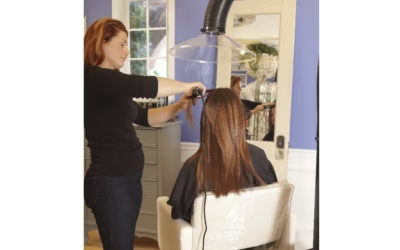
A source capture ventilation system removes vapors at the point of release, before they reach breathing zones. The SPA-H Hair Salon Fume Extractor uses a rigid flex extractor arm to position a capture hood directly overhead during color application and processing. Its multi-stage filtration system, which includes an activated carbon adsorption module formulated to filter VOCs, captures what the developer and alkalizing agents release in real time. Its multi-stage filtration system features 15 pounds of custom adsorption media formulated specifically to oxidize and neutralize harsh gaseous salon pollutants like formaldehyde. Available with a clean white, sleek black, or completely transparent hood option, it coordinates beautifully with high-end organic spa decors.
Because the SPA-H operates as a freestanding, recirculating unit on a caster base, it requires no ductwork or structural modification. It moves to whichever station is in active use, fits naturally into the salon footprint, and supports the meticulous, client-centered environment that organic salons work hard to create.
Establish a High Standard of Air Quality with a Hair Salon Fume Extractor
Organic salons attract clients who pay close attention to what goes into the products used on their hair and skin. Those clients deserve an environment where the same level of care extends to the air they breathe during their time at your salon. Providing a hair salon fume extractor at every color station shows clients that you are committed to a holistically high-quality experience.
Elevate your organic salon’s air ventilation. Contact us today to discuss solutions for your space.